

The International Symposium on “Chinese Modernisation in Global Historical Perspective” jointly organised by the Academy for Applied Policy Studies and Education Futures (AAPSEF) of The Education University of Hong Kong (EdUHK) and the School of Marxism of Xiangtan University was successfully held at EdUHK on 25 October. The symposium featured a stellar lineup of renowned scholars from Chinese Mainland, overseas countries and Hong Kong, offering participants multifaceted insights.
Professor Lee Chi-Kin John, Director of AAPSEF, delivered a welcome speech via video, emphasising that Chinese modernisation has provided valuable insights for the international community, with a hope that the event could foster cross-cultural understanding and collaboration. Professor Gu Minkang, Associate Co-Director of AAPSEF of EdUHK, also extended a warm welcome to all the participants.
Professor Chen Long, Executive Dean of the School of Marxism of Xiangtan University, praised Chinese modernisation as a long-term process ultimately achieving the goals of common prosperity and peaceful development, which offers an alternative route for developing countries to pursue modernisation.
The valuable insights of the 22 keynote speakers are summarised as follows:
- Professor Zhao Chaofeng (Professor, School of Marxism, Beijing Normal University)
Titled “The leadership of the Communist Party of China (CPC) is the fundamental guarantee for Chinese modernisation”, Professor Zhao’s presented that our country’s endeavours in effectively uniting people from all walks of life to participate in the modernisation process through a series of “Five-Year Plans”, ultimately achieving a moderately prosperous society in all respects. - Professor Hu Weixing (Dean, Faculty of Social Sciences, University of Macau)
Speaking on the theme of “The world’s historical significance of China’s modernisation”, Professor Hu emphasised that the world order has undergone a major transformation unseen in the past century, with the rise of China being the most striking example. He noted that China has developed a unique development path encompassing common prosperity, a green economy, and civilised governance. - Professor Maria Nikolakaki (Professor, Department of Social and Educational Policy, University of Peloponnese, Greece)
Professor Nikolakaki, in her presentation titled “Which path to modernisation? Beyond Western modernisation myths”, argued that as the deficiencies of capitalism eventually emerge, China's people-centred philosophy of harmony and shared prosperity is especially welcomed by ordinary citizens in Western countries. - Professor Juan R. Rodriguez-Fernandez (Professor, School of Education, University of León, Spain)
Speaking on the theme of “The role of public education in contributing to common prosperity: Issues for debate”, Professor Rodriguez-Fernandez praised China’s achievements in improving public education to cultivate civic awareness and assist future talents in addressing social challenges. - Professor Jin Wei (Professor, School of Marxism, Fudan University)
Professor Jin, speaking on the theme of “International communication of Chinese modernisation”, argued that social media could be effectively utilised to disseminate the advantages of China’s people-centred path of peaceful development in achieving common prosperity through arousing rational discussion and emotional resonance. - Professor Huang Xianzhong (Associate Director, The Research Centre of Mao Zedong Thought, Xiangtan University)
Titled “Pioneering China’s socialist modernisation: Mao Zedong’s explorations in the New Society”, Professor Huang's presentation argued that the concept of the “New Society” proposed by Mao aimed to establish a socialist country suited to China’s national conditions. - Professor Wei Yongkang (Department of English, University of Texas Rio Grande Valley, USA)
Titled “Discussing the ‘Rise of the East and the Decline of the West’ and historical materialism”, Professor Wei's speech reviewed China’s journey from a semi-colonial country to its current status with great achievements in poverty alleviation and military construction, praising China for being able to accomplish goals that other countries cannot. - Professor Lian Shu (Professor, Faculty of Humanities and Social Sciences, Tsukuba University, Japan)
Speaking on the theme of “An investigation into the role of Confucianism in Japanese modernisation”, Professor Lian reviewed how Japan oscillated between venerating Confucianism and imitating Western civilisation, ultimately failing to establish any development model that suited its own circumstances. - Professor Docent Gekht Anton Borisovich (Head, Department of History and Regional Studies, St. Petersburg State University of Telecommunications, Russia)
Professor Gekht, in his presentation titled “Marxist ideology and the modernisation of Russia in the 20th century: Assessments and opinions”, emphasised that the displacement of Marxist ideology led to the dissolution of the former Soviet Union, and argued that the mistakes made by the former Soviet Union had set a reference for China to avoid. - Dr Yang Fan (Assistant Professor of Teaching, National Security and Legal Education Research Centre, EdUHK)
Dr Yang, speaking on the theme of “Mediation, which is historically embedded in Chinese culture, can project China’s soft power globally to the benefit of a community with a shared future for mankind”, believed that the establishment of the International Organisation for Mediation headquarters in Hong Kong is a manifestation of the Chinese cultural spirit of valuing harmony on the international stage. - Dr Lai Chi-sing (Senior Lecturer, Department of Chinese Language Studies, EdUHK)
Speaking on the theme of “On Chinese modernisation: Is the ‘Vernacular Movement’ a rational social movement?”, Dr Lai argued that vernacular Chinese, with its large user base and ability to rapidly promote universal education, was conducive to advancing Chinese modernisation. - Professor Liu Hongsen (Associate Dean, School of Marxism, Beijing Normal University)
Titled “Re-examination of Mao Zedong’s thoughts on industrialisation”, Professor Liu's presentation recalled Mao's prioritisation of heavy industry development to advance national defence due to national security considerations. He hoped the Chinese citizens could uphold the principle of learning from foreign countries without excluding them. - Professor Docent Molchanova Tatyana Vyacheslavovna (Associate Professor, Department of History and Regional Studies, St. Petersburg State University of Telecommunications, Russia)
Professor Molchanova, speaking on the theme of “Foreign policy trajectories for promoting the China Brand”, argued that the government, business and cultural sectors should work together to promote the “China Brand”. - Professor Wang Feng (Associate Dean, School of Marxism, Southwest University)
Titled “Theory of the two-way interaction between human civilisation and agricultural and rural modernisation”, Professor Wang’s presentation emphasised that agricultural civilisation is the root of modern civilisation and urged the Chinese people not to abandon traditional culture while respecting foreign knowledge. - Professor Luo Siliang (Professor, School of Marxism, Sun Yat-sen University)
Speaking on the theme of “Modernisation with nationalisation as the norm: Mao Zedong’s thoughts on socialist literature and art modernisation in the 1950s”, Professor Luo reviewed Mao’s policy of learning from foreign countries without losing the national style in promoting the modernisation of literature and art. - Professor Li Fuqing (Associate Dean, School of Marxism, Xiangtan University)
Professor Li, in her presentation titled “An analysis of the connotation of Chinese-style modernisation from three dimensions”, reviewed China’s journey from speed as a first priority to emphasis on high-quality development, and praised our country for following a path of peaceful development which simultaneously preserves its excellent traditional culture and improves people’s livelihood. - Mr Chau Lap (Executive Co-Director, Centre for Classical Chinese Education, EdUHK)
Speaking on the theme of “The inheritance and international dissemination of China’s excellent traditional culture through the ‘New Six Arts’ general education course: Taking ‘Smart Chinese Characters’ as an example”, Mr Chau introduced the EdUHK’s “New Six Arts” course, which has transformed the Six Arts into a universal, practical, contemporary and internationally accessible curriculum, enabling students from different professional backgrounds to grasp their essence. - Professor Han Bujiang (Professor, School of Marxism, Nanjing University of Science and Technology)
Professor Han, speaking on the theme of “Mao Zedong’s world historical perspective and its enlightenment in exploring Chinese-style modernisation”, encouraged the Chinese people to promote modernisation with a mindset of seeking common ground while reserving differences, and to continue practicing innovation and testing their results without rejecting foreign insights. - Dr Xu Hao (Lecturer, School of Marxism, Hunan University of Science and Technology)
Speaking on the theme of “Mao Zedong’s practical exploration and practical enlightenment in combating ‘spiritual aggression’ after the founding of New China”, Dr Xu encouraged the Chinese people to uphold the principle of “learning from the West for the benefit of China”, i.e., absorbing advanced foreign culture while not blindly accepting it. - Miss Gao Yanli (Doctoral Candidate, School of Marxism, Xiangtan University)
Titled “A century of exploration and construction of the cultural leadership of the CPC”, Miss Gao's presentation argued that our country’s contemporary trend of valuing scientific and technological development while respecting talent and knowledge reflects that equal importance has been attached to both material and spiritual civilisations. - Mr Zhang Hongjun (Master’s Candidate, School of Marxism, Xiangtan University)
Speaking on the theme of “A theoretical analysis of the spiritual patterns of Chinese modernisation”, Mr Zhang argued that the essence of Chinese modernisation lies in promoting high-quality development, and enhancing history education is crucial in this process. - Mr Ma Jian (Undergraduate Student in Marxist Theory, Xiangtan University)
Titled “Chinese modernisation and Western modernisation from the perspective of historical materialism”, Mr Ma's presentation argued that Western capitalism, which emphasised on protection of private interests, had led to labour exploitation. This could be alleviated by Marxism, which emphasises on community.
Conclusion and future aspirations
The symposium featured lively discussions, bringing together insightful perspectives from experts and scholars from around the world. Finally, Professor Li Yanfeng , Assistant to the Dean of the School of Marxism of Xiangtan University, delivered a concluding speech, calling on everyone to apply traditional Chinese wisdom in addressing the challenges of the 21st century, and to contribute to the reshaping of the discourse systems and the creative development of diverse civilisations. All participants highly commended the event.
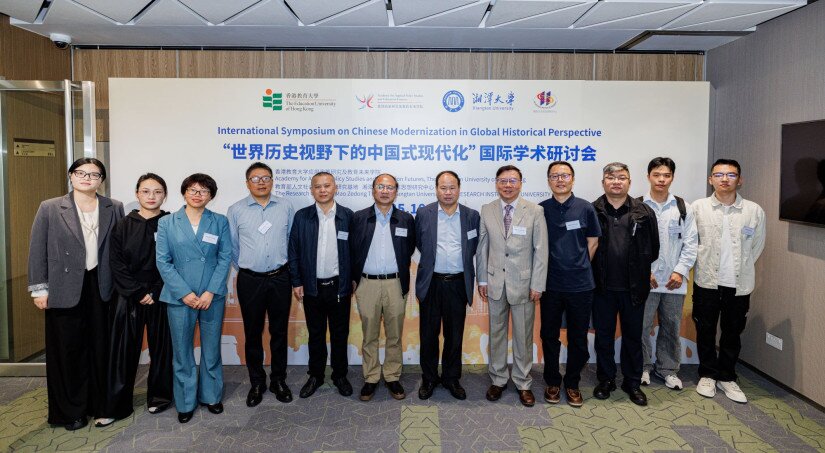 Group photo of Professor Gu Minkang (fifth from the right), Associate Co-Director of AAPSEF of EdUHK, and delegates from the School of Marxism of Xiangtan University, co-organiser of the International SymposiumNumber 1
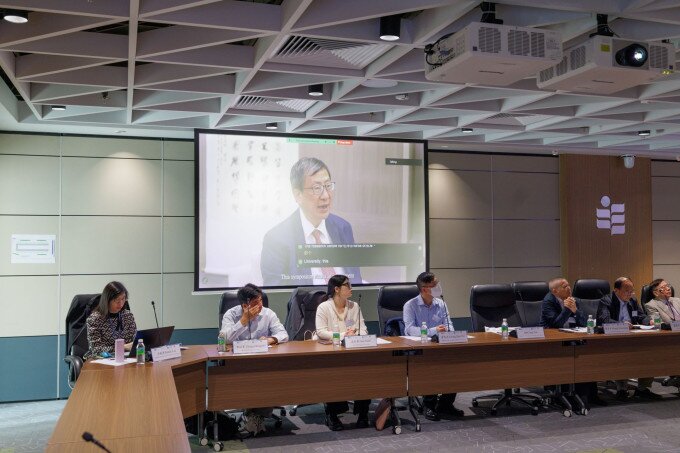 Professor Lee Chi-Kin John, Director of AAPSEF, delivers a welcome speech via video, emphasising that Chinese modernisation provides valuable insights for the international communityNumber 2
 Professor Gu Minkang (second from the right), Associate Co-Director of AAPSEF of EdUHK, delivers the opening remarks and extends a warm welcome to all participantsNumber 3
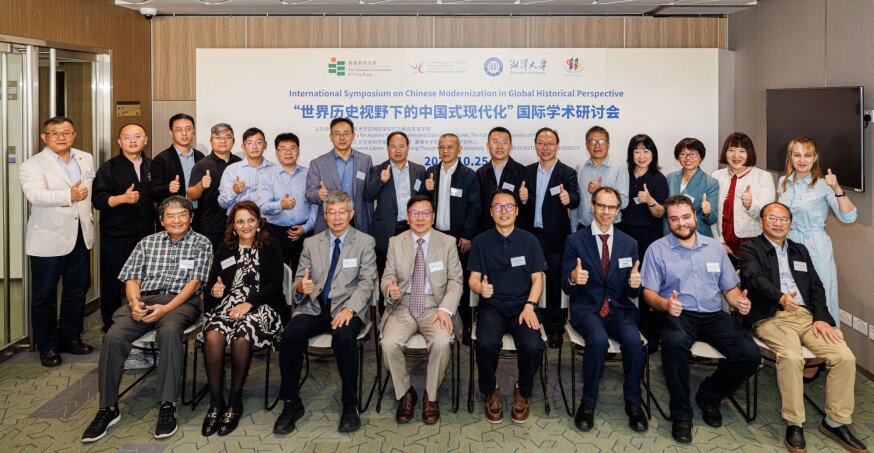 The International Symposium on “Chinese Modernisation in Global Historical Perspective” concludes with high commendations from the participantsNumber 4
 The conference is filled with lively discussions, bringing together insightful opinions from experts and scholars around the globeNumber 5